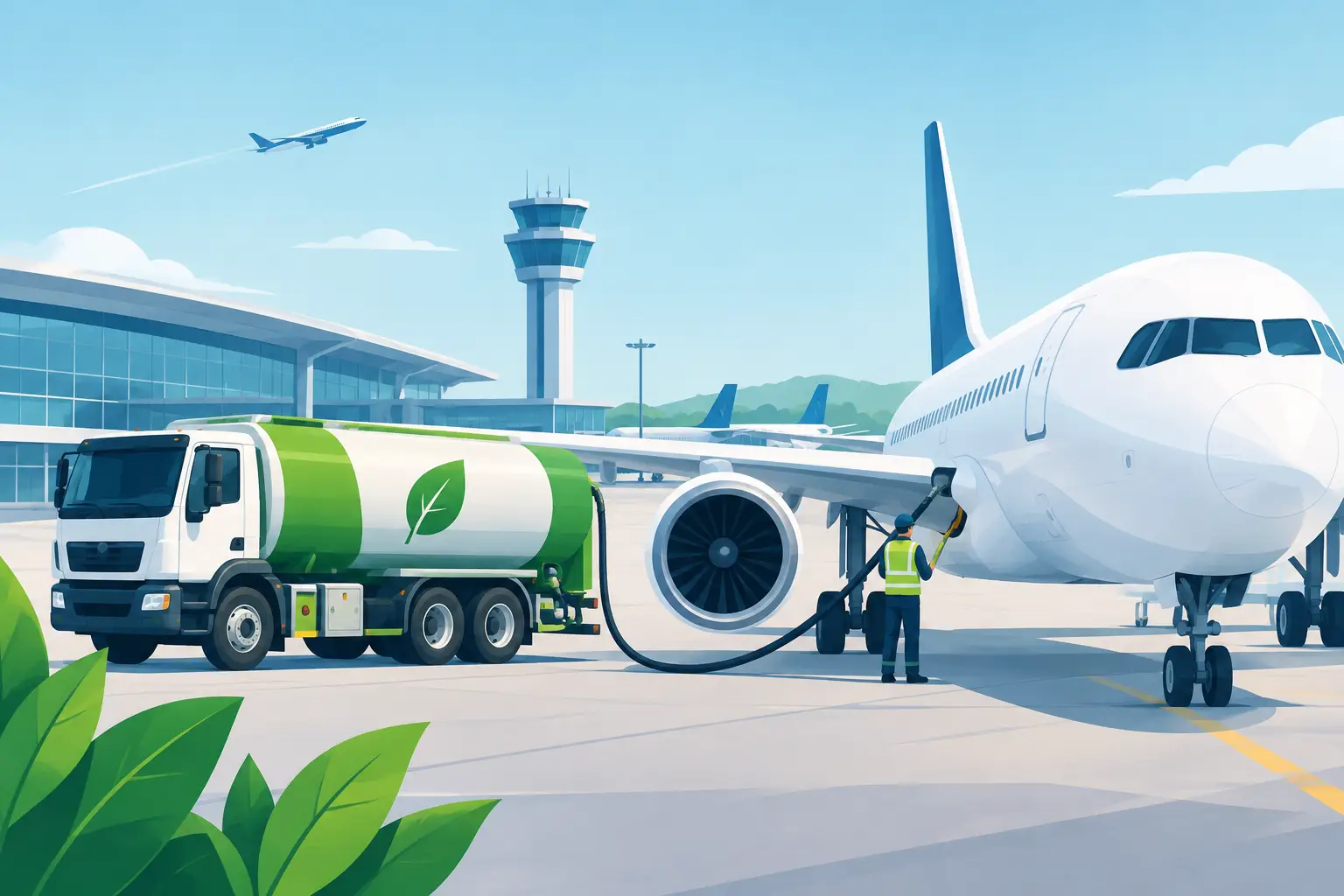
A refueling truck at the gate may be the most visible part of a sustainable aviation fuel program, but it is rarely where the hardest work begins. Leaders who want to implement sustainable aviation fuel must align fuel supply, airport infrastructure, airline demand, commercial risk, policy, and public trust long before the first physical delivery arrives.
Sustainable aviation fuel, commonly known as SAF, is not a symbolic purchase or a single procurement decision. It is an operating model for decarbonization in a sector where reliability, safety, cost discipline, and international coordination cannot be compromised. The organizations that lead well will treat SAF as both a climate priority and a leadership test: can they make difficult choices, build credible partnerships, and create value beyond their own balance sheet?
Why implementing sustainable aviation fuel is a leadership decision
Aviation has no simple substitute for liquid fuel on most commercial routes. Efficiency improvements, fleet renewal, operational changes, and emerging propulsion technologies all matter, but SAF is one of the few tools available now that can reduce lifecycle greenhouse gas emissions while working with existing aircraft and fueling systems, subject to applicable specifications and approvals.
That does not mean every SAF pathway delivers the same result. Lifecycle benefits depend on feedstock, production method, energy inputs, transport, and land-use impacts. A program that celebrates gallons purchased without examining those factors risks substituting a strong public message for genuine environmental progress.
For senior leaders, the central question is not, “Can we buy SAF?” It is, “What role can our organization credibly play in accelerating supply while protecting operational resilience and environmental integrity?” The answer differs by airport location, airline network, access to feedstocks, policy environment, capital capacity, and customer expectations.
An airport in a major fuel hub may be positioned to receive physical volumes through its established fuel system. A carrier operating globally may need a portfolio that combines physical offtake with book-and-claim mechanisms. A government may have the greatest leverage through incentives, standards, infrastructure approvals, and long-term policy certainty. Each stakeholder must be clear about its own role rather than expecting another party to carry the entire transition.
Start with an honest baseline
The fastest way to weaken a SAF strategy is to begin with a public target and work backward for evidence. Begin instead with a fact-based baseline. Map annual jet fuel demand by airport, airline, route type, season, and fueling arrangement. Identify where fuel enters the airport system, who controls storage and hydrant access, and what contractual provisions govern blended fuel.
Then assess demand quality. Is there an anchor customer prepared to make a multiyear commitment? Are corporate travel buyers willing to support the premium through a credible emissions-allocation model? Is the airport able to aggregate demand across resident airlines, or does competition law require a more carefully structured approach? These are commercial and governance questions, not merely sustainability questions.
The baseline should also identify the organization’s emissions-accounting boundaries and claims process. SAF certificates, lifecycle calculations, chain-of-custody records, and retirement procedures must withstand scrutiny from investors, regulators, customers, and employees. If a claim cannot be explained clearly to a board, it is not ready for a marketing campaign.
Define success beyond volume
Volume is necessary, but it is not enough. A credible scorecard should track the percentage of fuel demand covered, verified lifecycle emissions reductions, cost exposure, supply diversity, delivery reliability, and the quality of social and environmental safeguards.
Leaders should also measure whether their SAF program is creating capability. Are procurement teams learning how to evaluate contracts? Are operations teams prepared for revised fuel-handling procedures? Are local institutions gaining access to new skills, research opportunities, or jobs? A transition that leaves the workforce outside the room will struggle to earn durable support.
Build a supply strategy that can survive reality
SAF supply remains constrained in many markets, and early volumes often command a premium. That makes discipline essential. A strong strategy distinguishes between near-term access and long-term supply creation.
Near-term access may involve purchasing physically delivered SAF at selected airports, participating in a book-and-claim program, or supporting a supplier’s production expansion through an offtake agreement. These approaches can work together. Physical delivery demonstrates operational readiness and can support local momentum. Book-and-claim can direct investment toward production even when the fuel cannot be delivered where it is consumed.
The trade-off is transparency. With book-and-claim, the environmental attribute must be uniquely issued, transferred, and retired so that no other organization makes the same claim. With physical supply, leaders still need to understand how blending, transport, and documentation affect the final emissions calculation. Neither route is automatically superior. The right choice depends on the organization’s goals, available infrastructure, and claim requirements.
Long-term supply strategy requires a wider view. Feedstocks that appear attractive today may face competition from road transport, chemicals, agriculture, or other sectors. Some feedstocks raise questions about waste availability, indirect land-use change, biodiversity, water use, or community impacts. Sustainable sourcing cannot be reduced to a checkbox.
Airport and airline leaders should ask suppliers for traceability, lifecycle methodology, feedstock safeguards, production capacity plans, and clarity on what happens if planned volumes do not materialize. Price certainty is valuable, but a low-cost agreement that rests on weak sustainability evidence creates a different and potentially greater risk.
Create governance before making commitments
SAF initiatives cross functions that do not always share the same incentives. Finance focuses on cost and exposure. Operations focuses on safety and continuity. Commercial teams focus on customers and competitiveness. Sustainability teams focus on climate performance and reporting. Public affairs teams face questions from government and communities.
A steering group can coordinate these perspectives, but it must have decision rights, not simply a calendar of meetings. Establish who can approve contracts, who validates claims, who oversees supplier due diligence, and who speaks publicly about progress. Board-level oversight is particularly valuable when commitments span several years, involve material premiums, or depend on policy incentives.
The governance model should include a clear escalation path for difficult scenarios: a supplier misses a delivery, a lifecycle methodology changes, an incentive expires, or a public claim is challenged. Responsible leadership is not demonstrated by assuming these problems will never happen. It is demonstrated by preparing to respond without hiding behind vague language.
Make the airport a platform for partnership
No airport can manufacture a SAF ecosystem alone. Yet airports can be powerful conveners because they sit where airlines, fuel suppliers, ground operators, regulators, tourism bodies, investors, and communities meet.
The strongest airport-led programs bring those parties into one structured conversation around demand, infrastructure, permitting, incentives, and credible claims. This is particularly important where fuel farms, pipelines, or hydrant systems are operated by entities separate from the airport itself. Early technical engagement can prevent a late-stage discovery that a commercial agreement cannot be implemented safely or efficiently on site.
Governments should be engaged as partners, not only as funders. Policy consistency can shape investment decisions more than one-time announcements. Aviation leaders can provide governments with practical evidence on infrastructure needs, supply constraints, workforce requirements, and the consequences of poorly aligned rules across jurisdictions.
This is also where international leadership matters. A policy designed for one market may not translate directly to Asia-Pacific, the Middle East, or smaller island economies with different logistics and feedstock realities. Copying another region’s model without adapting it to local conditions is not strategy. It is wishful thinking.
Connect climate progress to people and opportunity
A credible SAF transition should strengthen the social license of aviation, not merely improve corporate reporting. Communities want to know whether sustainability investments will create accessible careers, support local education, and distribute opportunity fairly.
That starts inside the organization. Bring maintenance professionals, fuel teams, operations specialists, and emerging leaders into the work early. Their expertise will identify practical issues executives may not see, and their participation turns an initiative into institutional capability. Women and underrepresented professionals should be visible in technical, commercial, and leadership roles throughout the transition.
It should extend outward as well. Partnerships with schools, universities, and workforce organizations can make the energy transition tangible for young people who may never have imagined a future in aviation. Showing students that aviation needs engineers, environmental specialists, planners, technicians, data professionals, and ethical leaders broadens the talent pipeline while giving sustainability a human face.
For organizations seeking strategic advisory support, the most useful question is not whether SAF belongs in the sustainability report. It is whether the organization is prepared to lead a program that integrates operational excellence, commercial accountability, credible climate action, and community value.
The next meaningful step may be modest: convene the right decision-makers, map the actual fuel system, and agree on the evidence required before making a claim. Purposeful action begins when leaders replace broad ambition with a decision they are prepared to own.
Leave a Reply