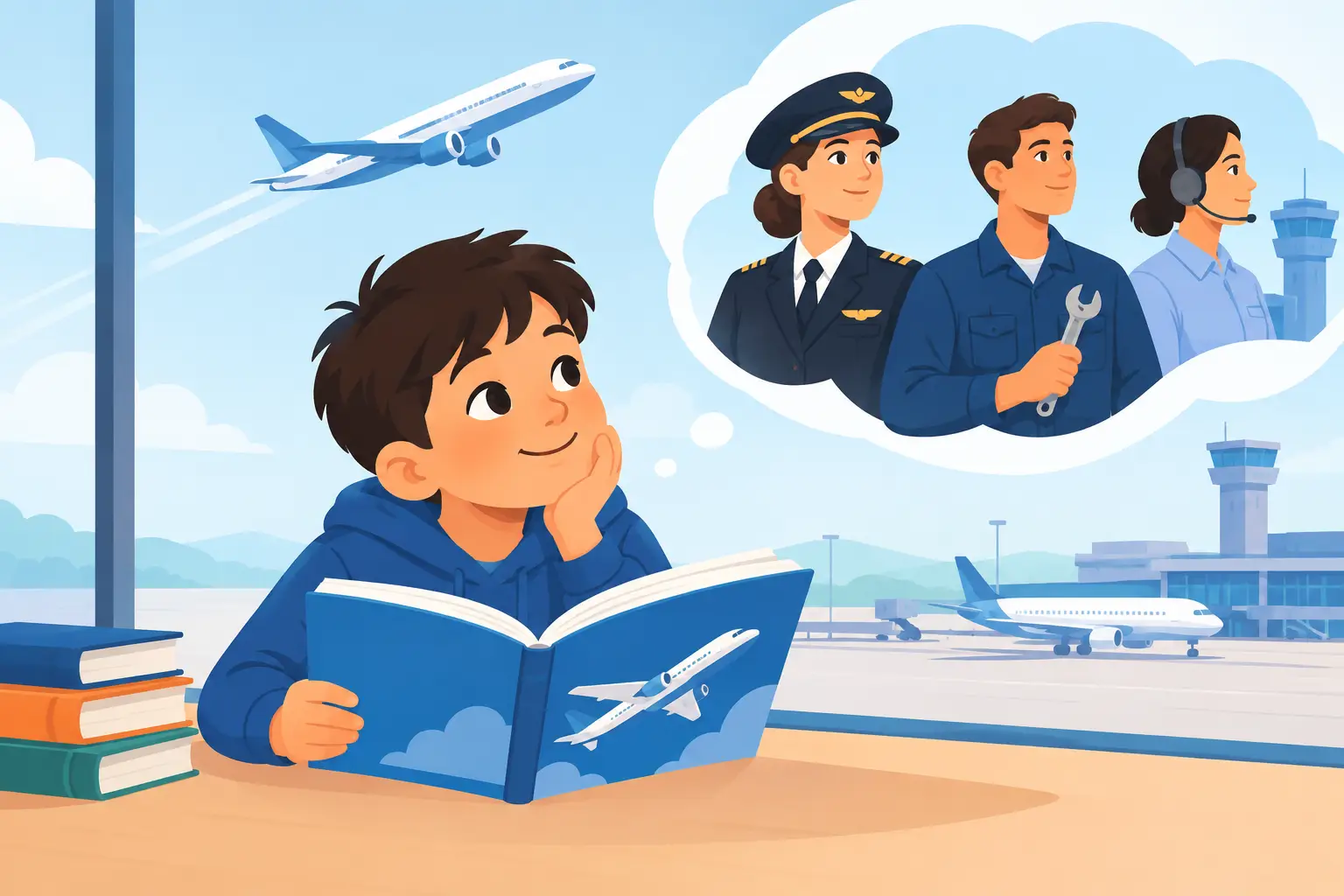
A child who sees an aircraft only as a vacation ride may never imagine the thousands of people responsible for getting it safely into the sky. Aviation books for kids can change that perspective early. They can introduce flying as a real, human industry – one shaped by pilots, engineers, dispatchers, airport teams, air traffic controllers, cabin crew, planners, and sustainability leaders.
For aviation organizations facing long-term workforce pressures, this is not a minor educational exercise. It is an opportunity to build awareness before career choices begin to narrow. When children can see themselves in aviation, they are more likely to ask better questions at school, explore science and technology, and recognize that the industry has a place for their talents.
Why Aviation Books for Kids Matter to Industry
The aviation sector often speaks about talent pipelines when recruitment becomes difficult. Yet workforce development begins much earlier than a job advertisement, a university partnership, or a graduate program. It begins when a child forms an idea of what is possible.
Books are especially powerful because they make an unfamiliar environment understandable. A well-written aviation story can explain how a bag reaches the right aircraft, why runway safety matters, or what a maintenance engineer does before departure. It can also show that flying is a team effort, not a profession reserved for a narrow group of people.
That distinction matters for inclusion. Many children, particularly girls and those from underserved communities, may have limited exposure to aviation professionals who resemble them or understand their circumstances. If stories repeatedly show only one type of person in the cockpit or the boardroom, the message is received long before anyone says it aloud. Diverse, credible representation helps children picture a future in aviation without needing permission to belong.
For airlines, airports, MROs, aviation associations, and public agencies, investing in early exposure also supports a broader social license to operate. Communities are more likely to value aviation when they understand its contribution to connection, commerce, emergency response, tourism, and opportunity. The strongest initiatives do not treat children as a marketing audience. They treat them as future citizens, future professionals, and future decision-makers.
What Makes a Good Aviation Book for Children?
Not every aviation-themed book serves the same purpose. Some are designed to spark imagination through the excitement of travel. Others explain technical ideas in age-appropriate language. Both have value, but organizations should be clear about the outcome they want to support.
For younger readers, engaging characters, visual storytelling, and simple explanations are essential. The story should feel joyful without becoming superficial. Children can understand that safety checks, teamwork, weather, and careful planning are part of every flight when those concepts are presented through relatable moments.
For elementary-age readers, books can go further. They can introduce the many roles behind an aircraft departure, the difference between an airport and an airline, or the ways aviation is working to reduce its environmental impact. At this stage, accuracy matters. Simplifying a concept is not the same as misrepresenting it.
The best books share several qualities:
- They show a range of aviation roles, including work on the ground, in operations centers, and in technical teams.
- They represent people across genders, cultures, abilities, and backgrounds with respect rather than tokenism.
- They make safety, responsibility, and collaboration visible.
- They encourage questions instead of presenting aviation as a closed world only experts can enter.
- They connect the excitement of flight with real pathways in education and work.
A book does not need to turn every child into a pilot. Its role is to widen the horizon. A child who loves problem-solving may later find engineering. A child interested in geography may be drawn to network planning. A child motivated by climate action may discover sustainable aviation fuel, airport decarbonization, or environmental planning.
From a Book to Meaningful Career Awareness
A book has the greatest impact when it is part of an experience rather than a standalone giveaway. This is where aviation leaders can bring strategic intent to community investment.
An airline may pair a children’s book with an employee reading day at local schools. An airport can include it in a youth outreach program, then invite students to meet the people who manage baggage systems, wildlife safety, airfield operations, or terminal accessibility. An aviation authority might use it as the starting point for a classroom activity about weather, maps, or sustainable transport.
The goal is not to overload young children with career advice. It is to create a meaningful bridge between a story and the people who make aviation work. A child who meets an aircraft technician, an airport manager, or a female pilot is more likely to retain the message that aviation careers are real and attainable.
This approach also gives corporate social responsibility programs a clearer long-term purpose. Donating materials can be useful, particularly where schools have limited resources. But impact becomes more credible when organizations define who they are reaching, why those communities matter, and what happens after the books are distributed.
For example, a partnership could prioritize schools near an airport, rural communities with limited career exposure, or organizations supporting girls in STEM. It could include teacher materials, staff volunteers, airport visits where appropriate, and a simple method of measuring participation and feedback. The right design depends on local needs, safeguarding requirements, and available capacity. A small, consistent program can be more valuable than a large launch with no follow-through.
Representation Is a Workforce Strategy
Aviation has made progress, but many visible technical and leadership roles remain underrepresented by women and other groups. The industry cannot solve this only at the recruitment stage. By then, some young people have already decided that aviation is not for them, or have chosen subjects without realizing how many pathways exist.
Representation in children’s content should therefore be treated as a workforce strategy, not a cosmetic feature. A young reader should encounter women in command, technicians solving problems, leaders making difficult decisions, and diverse teams working across borders. They should also see that aviation needs people who communicate well, care about communities, understand data, design systems, and lead with integrity.
That wider picture is important because aviation is changing. Digital operations, sustainability requirements, infrastructure investment, supply-chain resilience, and changing passenger expectations are expanding the capabilities the sector needs. Future talent will not come from one traditional route. It will come from children whose strengths are recognized early and whose curiosity is supported consistently.
Special North was built with this purpose in mind: to show young children what flying really looks like while helping industry partners connect education, inclusion, and long-term workforce readiness. The underlying principle is simple. If the industry wants a stronger and more diverse future, it must be willing to invest in who gets invited to imagine it.
How Leaders Can Evaluate an Education Partnership
Senior decision-makers should expect more than attractive branding from a children’s education initiative. The right partnership should align with corporate values, local community priorities, and a practical talent-development agenda.
Start with relevance. Does the content accurately reflect aviation and the organization’s role in it? An airport may want material that highlights the many professions across its ecosystem. An airline might focus on the journey of a flight and the teamwork behind customer experience and safe operations. A sustainability-focused partner may want children to understand that the future of flight requires innovation and environmental responsibility.
Then assess accessibility. Can the materials work in classrooms, libraries, community centers, and homes? Are they appropriate for the age group? Are they culturally sensitive for the communities being served? Translation, illustration choices, and educator support can all determine whether a program feels genuinely inclusive.
Finally, define what success looks like. Meaningful measures might include the number of children and schools reached, educator feedback, volunteer participation, repeat engagement, and the diversity of communities involved. Longer-term outcomes are harder to attribute, but they are worth observing: increased awareness of aviation careers, stronger school partnerships, and a more visible pathway for young people to engage with the sector.
Numbers alone are not the whole story. A meaningful comment from a student, a teacher who requests another session, or an employee who chooses to become a mentor can reveal whether the initiative is building trust. The strongest programs combine measurable reach with evidence of lasting relationships.
A Responsibility Worth Taking Seriously
Aviation connects people and possibilities across borders. It also carries a responsibility to ensure that opportunity is not limited to children who already have family connections, financial access, or proximity to the industry.
A thoughtful book can be a small object with a far-reaching effect. It can tell a child that the cockpit, the hangar, the operations center, the design office, and the leadership table are not distant places for other people. They are places where curiosity, preparation, courage, and purpose can lead.
When aviation leaders place that message in the hands of children, they are not simply supporting literacy or visibility. They are helping shape an industry that future generations can recognize as theirs to lead.
Leave a Reply